
We Are Church Intl.

News and Media Releases

Latest News

Collegiality, Justice and Pastoral Wisdom

[French] - [Portuguese] - [German] - [Spanish] - [Italian]


The opening day of the Conclave has not yet been decided; but today as in 2005, there are great expectations that this might mark a turning point in the Church and make the gospel of Jesus more and more heard in ourworld. The problems experienced during the pontificate of John Paul II are still unresolved, or have worsened.  Nonetheless the conviction remains that the situation can change for the Word of salvation is powerful.


It is the duty of the College of Cardinals to recognise the seriousness of the situation, to read the signs of times. The Cardinals have in their hands both the book of the Gospel and the documents of the Second Vatican Council. They must read them, and meditate on them. Within them are the directions, sometimes implicit but often very explicit, for the road the Church must travel. The expectations of those who appeal to the Council have already often been voiced. “We are Church” has contributed to raising issues about the Church as a whole, but with especial emphasis on the reform of the Papacy, because that is the key to the entire structure of what is the modern Catholic Church. We shall briefly recall four main issues.
 

Read more: Collegiality, Justice and Pastoral Wisdom

Dysfunctional Church needs to change declares UK's Baroness Kennedy.


Baroness Helena Kennedy QC is calling for major changes in the Catholic Church and says the current crises are in large part the result of church power being invested in one gender, which is wholly unacceptable in the 21st century.


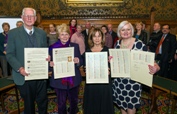
From L to R:  John Wijngaards, Professor King, Baroness Kennedy and Siobhain McDonagh MP

Lady Kennedy joined forces with Lord Hylton and feminist and spiritual writer Professor Ursula King at the Houses of Parliament (Tuesday March 5) to sign the Catholic Scholars’ Declaration on Authority in the Catholic Church.


The Declaration, calling for a more collegial system of church governance in the church, has already gained the backing of 180 leading theologians and Catholic Scholars worldwide. It has already been submitted to more than 20 cardinal electors in Rome this week.


Professor King signed the Declaration on behalf of women in the church, Lord Hylton signed on behalf of the underprivileged and marginalised, and Lady Kennedy added her signature for all men and women suffering from misguided church rulings on sexual ethics including contraception, homosexuality, divorce and remarriage.

Read more: Dysfunctional Church needs to change declares UK's Baroness Kennedy.

AUTHORITY IN THE CATHOLIC CHURCH


CATHOLIC SCHOLARS' DECLARATION ON AUTHORITY

Italian Portuguese Spanish francais
English Nederlands Polish Deutsch


Dr Paul Collins speaks about the Church and the Papacy

 Paul Collins, historian, author, former Catholic Priest and ABC Broadcaster, talks about the Catholic Church, the Papacy, his relationship with the church and his latest book The Birth of the West.


Appreciation for Pope Benedict XVI’s resignation

IMWAC (International Movement We Are Church) is surprised at Pope Benedict XVI’s resignation and wants to express its sincere appreciation for the Pope's decision. In the final phase of Pope John Paul II’s illness, the possibility of a pope’s resignation was already advocated by IMWAC. With Pope Benedict’s resignation, the Church avoids the danger of having a church run by people who speak and decide on behalf of the Pope who is seemingly no longer able to fulfill his duties. It also reduces the glorification of papacy and allows viewing the pope as a human being and as a bishop among other bishops, even though he is an important symbol of unity for the communities of the believers. IMWAC hopes that the leaders of the Church will advance in this direction so as to give more importance to the aspect of humaneness in the church and also to other issues. For example, the electoral college of the pope should represent the plurality of the Catholic Church at large, of the rich and the poor, of men and women and not only of clerics.

Benedict XVI’s decision to resign also sheds a light on the situation the Church is currently in. We expect great changes to take place in the future provoked and fostered by emerging cultures, relations between religions and between nations. Ours is the time of change, yet the leaders of the Church refuse to adapt. By resigning Pope Benedict seems to demonstrate that traditional church structures can be changed. IMWAC will issue a critical assessment of Pope Benedict’s papacy in due time and will also initiate and organize a monitoring meeting in Rome at the time of the conclave.

IMWAC wishes Pope Benedict all the best for the future.