
The feast day of "Peter and Paul", 29 June, is traditionally the day when men, committed to life-long celibacy are ordained in the Catholic Church. But again this year many cathedrals will remain empty because there are no such candidates. Many Catholics have been calling for decades for the Church to welcome women and married people into the Ministerial Priesthood. Candidates are available.
The church reform movement "We are Church", however, is now treading new ground: Many Christian congregations have long been developing new ways in pastoral care and liturgy and are coping wonderfully with a new understanding of themselves as a priestly people without ordained clergy. Pastoral care is obviously more alive and more capable of change than canon law; practice is overtaking theory.
The crisis of the Church is in many ways a crisis in the understanding of priesthood. In particular, the Catholic understanding of presbyterial ordination is in urgent need of revision: The idea that ordination would bring about a transformation of being in the candidate and make him a "representative of Christ", even an "other Christ", who as such is above all non-ordained persons, must be abandoned, as must the discriminatory focus on celibate men.
Instead, it must be recognised that Jesus did not ordain anyone at all and that the installation of priests (sacerdotes) in the Catholic Church was an invention of the 3rd century, as theological and church-historical research clearly proves today. In an effort to shape and live the Church as Jesus wished the community of his followers to be, ordination in the Catholic Church must therefore be completely rethought.
"We are Church" therefore advocates a recognition of the consecration of all the people of God at Baptism and the introduction of the sacramental commissioning of chosen women and men into ministry and pastoral care.
Colm Holmes
Chair, We Are Church International
M +353 86 606 3636
 We Are Church International strongly supports the work of the German Synodal Path which follows the principle ‘what affects all should be decided by all’. The church in Germany is fortunate to have a structure which allows lay women and men to work with the clerics how best to follow Christ today.
 The Principles for a Charter of fundamental rights and responsibilities for Catholics were articulated by the Ordinary Synod of Bishops in 1971. Its final document was entitled “Justice in the World.” Importantly, the document preserves the remaining core of a larger project commissioned by Paul VI at the conclusion of the Second Vatican Council. It came to be known as the Lex Ecclesiae Fundamentalis (The Basic Law of the Church) and was meant to stand alongside of Paul’s Credo of the People of God. Together they were intended to capture Vatican II’s evangelical vision and mission of the Church and function as the moral principles that would inform the interpretation of Canon Law as well as provide a guide for the life and governance of the Church. Most importantly, the moral foundations of right relationship in the Christian community are grounded in the teaching of Jesus: So, whatever you wish that others do to you, do to them; for this is the Law and the Prophets. (Mt 7: 12).
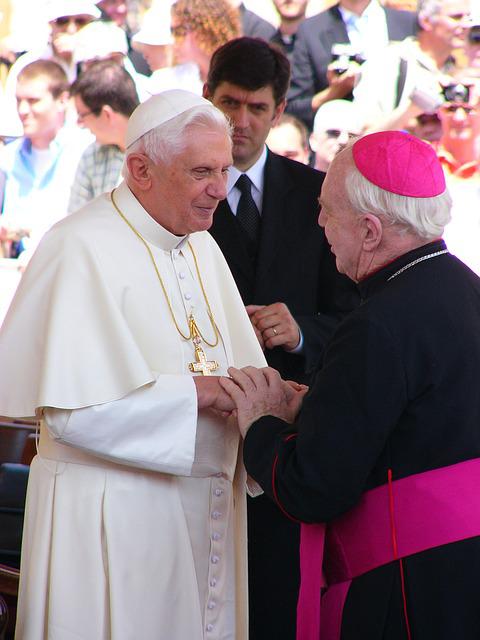 We are Church on the occasion of Joseph Ratzinger's 95th birthday 16 April 2022