We Are Church Intl.

News and Media Releases

Latest News

‘The renewal process must now be tangibly continued at all levels!’

We are Church - Germany at the conclusion of the World Synod

Post release: We are Church - Germany welcomes Pope Francis' statement: ‘... For this reason, I do not intend to publish a ‘post-synodal apostolic exhortation’ ... in the light of what has emerged from the synodal path, there are and will be decisions that need to be taken.’ > Wording: Pope's final address to the synod

Press release, Rome/Munich, 26 October 2024
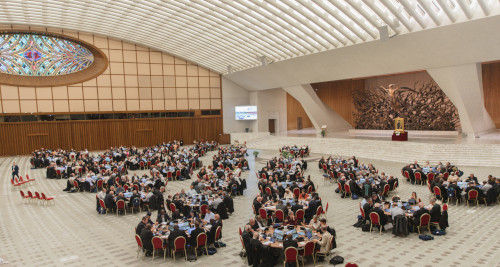
We are Church - Germany draws a mixed conclusion from the conclusion of the XVI Ordinary General Assembly of the Synod of Bishops, on whose final document will be voted today, and calls for genuine and concrete synodality at all levels of the church.

With the synodal process with worldwide participation, including at the grassroots level of the church, Pope Francis has made a church-historical turnaround that builds on the baptismal dignity of all, will have a long-term effect and be irreversible. But even at this second session, it has not yet been possible to resolve the clear contradiction between the early Christian message of the equality of all believers (‘Equality’) and the current dogmatically entrenched church power structure. This applies particularly to the exclusion of women, who had a central role in the early church, from all ordained ministries.

Unresolved ‘women's issue’ shows the power problem of the men's church

The worldwide exposure of the spiritual and sexual abuse of power and its cover-up has led the Catholic Church into a deep existential crisis. However, the Roman Catholic Church is also in a constitutional crisis because, after the Second Vatican Council, the right of the episcopate was overemphasised and the right of the people of the church was underemphasised and women's rights are not recognised. The Catholic Church's traditional Christian view of humanity is no longer convincing either. It will not be enough to strengthen the role of women only within the existing canon law if only men continue to define the role of women.

The highly non-transparent approach of the Pope and the new Prefect of the Dicastery for the Doctrine of the Faith, Cardinal Víctor Manuel Fernández, to the ‘women's issue’ is unsynodal and has lost a great deal of trust, but has also triggered strong opposition. The continuing discrimination against women shows how little respect there is for the baptismal dignity of women and how the traditional, male-dominated power structures are being held on to instead. The legacies of the previous Popes, ‘Inter Insignores’ (1976), ‘Mulieris dignitatem’ (1988) and ‘Ordinatio Sacerdotalis’ (1994), still weigh heavily on the Church today.

From now on, synodality must be practised in a concrete way at all levels of the Church!

For the synod members, the two assemblies in Rome were an intensive learning process, which must now be courageously implemented in Rome and in the individual local churches and later also evaluated.

From now on, the investigation and prevention of sexualised violence must be made a ‘matter for the boss’ everywhere.

From now on, the churchgoers are to be responsibly involved in all essential decisions at the respective levels. Transparency and accountability apply not only to the Pope, but to all believers.

From now on, synodal structures are to be created at the country and continental level, as is already successfully practised in Latin America and Asia. Here, Europe in particular has a lot of catching up to do.

From now on, decentralised solutions are to be allowed in all pastoral matters that correspond to the respective cultural context and are indispensable for an inculturation of the faith.

From now on, the Roman study groups must incorporate the current state of theological research in a transparent manner and include current pastoral requirements.

From now on, the synodal path in Germany, which has been given a tailwind by the deliberations in Rome, must be continued unabated.

From now on, the diaconal work of the church in following Jesus must be brought to the centre. This concerns everyone, men and women.

From now on, the church must not only concern itself with itself. It must change because it has a mission in the world (cf. Council Decree ‘Gaudium et Spes’).

Second Council session on 16 November 2024 in Stuttgart

We Are Church - Germany has critically followed the synodal path in Germany as well as the worldwide synodal process from the beginning. We Are Church - Germany sees it as a success that the reform issues formulated in Austria after the 1995 abuse scandal in Vienna around Cardinal Hans Hermann Groër – participation, women's ministries, exemption of celibacy and sex education – are now finally being openly discussed in Germany and Rome.

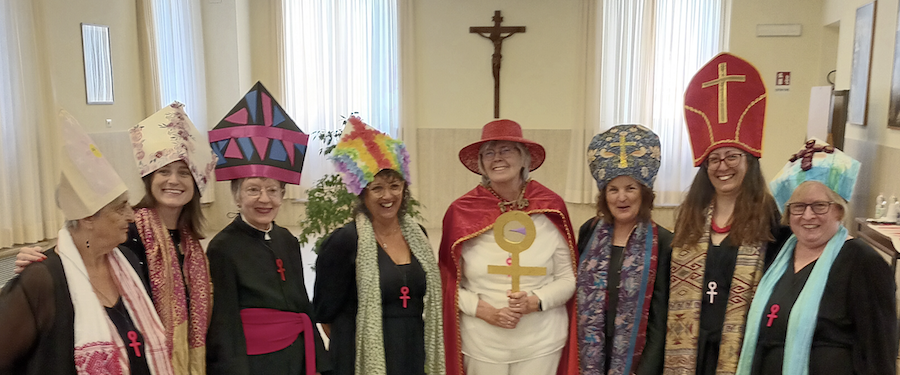
We Are Church International scripted and performed VATICANELLE in Rome on 12 October 2024.

VATICANELLE is a parody with seven Women bishops and Pope Sister Martha in a Synod of Bishops discussing if men could be ordained. After a long discussion a clear decision is made: Ad Experimentum suitable men will be ordained as priests and deacons in those communities that wish to take this opportunity. The motion is approved by a vote 6 - 2.

Here is the link to the video on our YouTube channel.https://www.youtube.com/watch?v=jftG2j7Dl5c  

Here are some quotes from the discussion:

In both the Old Testament and New Testament, the theme of the ‘exodus’ - the exodus from enslaving constraints - is a leitmotif: God hears the cries of the oppressed, while she topples the ‘mighty’ from their thrones and exalts the lowly (Luke 1:52)

And for the climax of YAHWH's work for her people, it says: ‘when the time was fulfilled, God sent her Son, born of a woman ...’ (Gal 4:4). It was the divine plan to choose a woman to begin the divine act of redemption without the intervention of a man.

St Joseph is recommended as a role model for all men – it is called the “Josephine principle”!!

Can men be priests when they are more used to thinking in terms of laws and are not used to asking for mercy?

Can men be priests if they so often make women invisible, even in subtle ways, in texts, in writings, in translations, even trivialising their concerns and not taking their wishes seriously?

Can men be priests if they want to lead instead of serve?

Can men be priests if their history is a chain of atrocities against women: rape, oppression?

One would have to fear that they would take advantage of their position and sexually exploit women and children, especially nuns and altar servers?

And they are much too emotional. You only need to watch them at sporting events!

... but unfavourable external circumstances, damp southerly winds and the like, result in boys by chance, not planned, not intended. So a boy has no intrinsic value, but is rather a ‘failed woman’. For this reason, the man is ascribed a multiple inferiority.

They said, men are mentally the weaker, physically the more active, therefore also morally the more vulnerable - and becomes a temptation for the woman. - I don't think we can call this a Christian doctrine!

It remains undisputed, however, that the typically female activities of caring, the ability to reconcile and to work together are still far more pronounced in women. Men have not been able or willing to sufficiently develop the feminine side of their humanity. Who normally looks after a baby? Who cares for the sick? Who keeps the peace in the family? Who cooks?

Vatican echo chambers

Nothing new on the topic of women's ordination from the Vatican

From the German by Martin Schockenhoff

At the first session of the World Synod in October 2023, the topic of women's ordination was discussed intensively. In particular, it was decided to examine the possibility of admitting women to the diaconate and to put it on the agenda for the second session. Some, including the Chairman of the German Bishops' Conference, Bishop Bätzing, considered the diaconate for women to be achievable in the foreseeable future.

In March 2024, Pope Francis surprisingly removed the topic from the agenda of the World Synod. He explained that this topic still required further theological clarification and set up a working group outside the World Synod for this, as well as for other issues such as priestly forms of life.

This caused disappointment and indignation among many. It became apparent that, contrary to the Pope's wishes, the topic of women's ordination would be discussed at the World Synod after all. On the first day of the second session, Cardinal Manuel Fernández, Chairman of the Dicastery for the Doctrine of the Faith, told the astonished delegates that his dicastery was preparing a document on the ordination of women. This would contain statements on the charisms of women, including the possibility of their assistance in sacramental acts. However, the document will not contain a positive decision on the admission of women to the diaconate.

This announcement right at the beginning of the second session was clearly intended to make it clear to the delegates that they had better not even deal with the topic of women's ordination, because any announcements from the World Synod would in any case be outdated by the document announced by his dicastery. In the further course of the second session, the delegates were presented with the interim results of the external commissions appointed by the Pope, including the interim result of Working Group 5 concerning the possibility of ordaining women. The original Italian version of the interim report, which consists of just under two pages, is also available in English translation. The content of this interim report confirms the fears of all those who had hoped for progress. Right at the beginning, the topic is limited to the ‘participation in decision-making processes and the leadership of communities’ of women. By ‘decision-making’, the Pope and the Vatican mean the stage of mutual listening, consideration and discussion that precedes the actual decision. The participation of women in the decisions themselves is not up for discussion from the outset.

The admission of women to the diaconate was obviously not dealt with independently in Working Group 5. Rather, the interim report unequivocally refers to the statements of the competent Dicastery for the Doctrine of the Faith:

‘Regarding the latter topic [the question of the admission of women to the diaconate] we would like to share from the outset ... that the Dicastery judges that there is still no room for a positive decision by the Magisterium regarding the access of women to the diaconate.’

In the following, it is explained that some important women in early church history and also today would have possessed significant authority and exercised influence even without ordination to the diaconate. Hildegard of Bingen, Catherine of Siena, Teresa of Ávila, Maria Montessori, Dorothy Day and Madeleine Delbrêl are cited as examples.

The interim report ends with the words:

‘In the light of these beautiful testimonies, the question of women's access to the diaconate takes on a different perspective. Meanwhile, the in-depth study of their multifacited Christian witness can help today imagine new forms of minis-try that can create still broader opportunities for a more incisive female presence in the Church (Evangelii Gaudium, 103).’

To summarise,

it should be noted that Working Group 5, whose members were not made known to the delegates of the World Synod, has not yet undertaken an independent examination of the question of the ordination of women.

It has limited itself to reproducing the statements of the Dicastery for the Doctrine of the Faith and the work programme announced by it.

This working group, if it exists at all, will not undertake an independent examination.

On the basis of the interim report, it can be assumed that its final report will be limited to confirming the content of the paper on the ordination of women announced by Cardinal Fernández.

In other words: Working Group 5 is a Vatican echo chamber.

Group 5
Some Theological and Canonical Matters
Regarding Specific Ministerial Forms (SR 8 and 9)

Vatican says NO to EQUALITY?

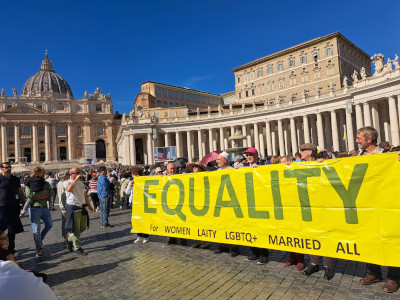
As Pope Francis said the Angelus to a packed St. Peter’s Square on Sunday 13 October 2024, We Are Church International (WAC) raised a banner to EQUALITY in support of Pope Francis.

Within 5 minutes the WAC group was surrounded by police who ordered the banner to be taken down and detained 7 of the WAC group for up to 4 hours.

Expressing support for Pope Francis with a banner for EQUALITY as followers of Jesus should be readily acceptable.

This is a key topic at the Synod being held in the Vatican City state, which Pope Francis initiated in 2021.

We totally accept the need to protect Pope Francis from attack and the long queues and security checks are essential and warranted.

But the Vatican security system should not be used to promote only conservative voices, when many reform voices also support Pope Francis.

Unity in diversity must apply in the Vatican City state as well as in the global church.

#######

Press contacts:

Colm Holmes, Chair We are Church International
Email: This email address is being protected from spambots. You need JavaScript enabled to view it. Phone: +353 86606 3636

Dr Martha Heizer, Vice-Chair We are Church International
Email: This email address is being protected from spambots. You need JavaScript enabled to view it. Phone: +43 650 4168500

‘The many knots of the reform backlog must be untied – in Rome and in the local churches’

  • We Are Church on the current World Synod in Rome
  • Dispute over anthropology, theology and the image of women
  • Conference of We Are Church International 11-14 October 2024 in Rome

We Are Church on the current World Synod in Rome

We Are Church sees the second plenary assembly of the World Synod, which is currently meeting, as a logical step towards finally bringing the participatory understanding of the church of the Second Vatican Council (1962-1965) to life at all levels. The tense discussions and polarisation inside and outside the Synod hall show how urgently this transformation process is needed. The Roman Catholic Church leadership cannot afford to ignore the ‘signs of the times’ again, as it did before the Second Vatican Council.

The decisive question for the future is whether the expanded Synod of Bishops of Pope Francis can succeed in resolving the backlog of reforms and fundamental contradictions with regard to the core of biblical tradition – the exclusively male clergy, excluding women from all consecrations and central decisions. If the return to the dignity of baptism is a decisive characteristic of church membership, then this must lead to a new theology and a reorientation of all church structures, which are to be designed as services and not as offices and privileges.

If the Roman Catholic Church, the largest Christian church and the world church, were to succeed in exemplifying a gender concept that corresponds to the early Christian message, it could be a credible and radiant role model. This would be a truly prophetic testimony.

Debate on anthropology, theology and the image of women

Pope Francis' statements at the Catholic University in Belgium regarding the image of women and the rigid adherence to a dualistic anthropology are out of touch with the times. Just one day after Cardinal Kevin Joseph Farrell, Prefect of the Dicastery for the Laity, Family and Life, admitted the Church's manifold failings towards women, Cardinal Victor Fernandez, Prefect of the Congregation for the Doctrine of the Faith, announced a new doctrinal document on the role of women in the Church and rejected expectations of the women's diaconate. The time is not ripe yet. This is a new affront to all women and contradicts the desired synodality.

We Are Church is pleased that the statements of the Pope and the announcement of the Prefect of the Congregation for the Doctrine of the Faith are no longer accepted without contradiction. According to many reformers within the Church, the question of the women's consecration is no longer about whether, but when and how. Therefore, the members of the World Synod and all those in the Vatican now have a great responsibility to undo the many old knots that contradict the Christian message. We Are Church also expects each individual bishop to now commit themselves wholeheartedly to the principle of synodality and to act in a truly synodal way at all levels.

The reforms that have been delayed since the Second Vatican Council must finally be implemented if talk of God is not to become hollow. Questions about God, structural issues and serving people must not be played off against each other! Only if the church has the courage to reform its own structures will it also have the moral strength and authority to comment on current problems and fulfil its many tasks in society.

Conference of We Are Church International 11-14 October 2024 in Rome

As in the previous year, the worldwide association We Are Church International will hold its annual meeting under the motto ‘EQUALITY’ during the synod in Rome in order to seek contact with the participants of the world synod and to promote reforms. In addition, a new coordination team will be elected. The meeting will take place at Casa Maria Immaculata from 11 to 14 October 2024.

Activities of all reform forces during the synod in Rome.

Press contacts:

Colm Holmes, Chair We are Church International
Email: This email address is being protected from spambots. You need JavaScript enabled to view it. Phone: +353 86606 3636

Dr Martha Heizer, Vice-Chair We are Church International
Email: This email address is being protected from spambots. You need JavaScript enabled to view it. Phone: +43 650 4168500